VR in Product Design: How Virtual Reality is Revolutionizing Product Prototyping
Discover how Virtual Reality (VR) is transforming product design and prototyping. Learn how businesses can reduce costs, accelerate innovation, improve collaboration, and visualize products before manufacturing with immersive VR solutions from 360 VR Photography.
VIRTUAL REALITY
VR in Product Design: Prototyping Made Easy
How Virtual Reality is Revolutionizing Product Prototyping
Introduction: The Costly Hurdle of Physical Creation
Bringing a brand-new product from an initial concept to the retail shelf has traditionally been a long, exhausting, and incredibly expensive journey.
The traditional workflow rarely changes: designers create 2D sketches, engineers convert them into complex CAD models, and then manufacturers spend weeks building physical prototypes. Teams look for flaws, scrap the physical model, adjust the design, and wait for a new prototype to be manufactured. This repetitive cycle burns through substantial material costs, engineering hours, and operational resources.
Today, spatial computing is completely rewriting this playbook. Virtual Reality (VR) is revolutionizing how modern products are designed, structurally evaluated, and approved.
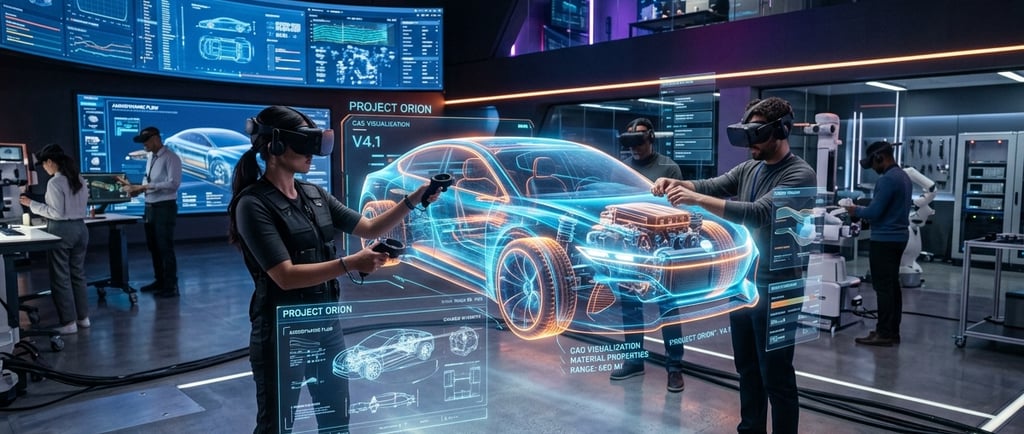
With immersive hardware, development teams can step directly inside their concepts, examine models at a true 1:1 scale, test spatial ergonomics, and isolate catastrophic structural flaws before a single piece of raw material is cut. VR is moving prototyping away from sluggish physical manufacturing into an era of real-time, interactive digital execution.
What is VR Product Design?
VR product design bridges the gap between digital modeling and physical spatial awareness. Instead of analyzing a three-dimensional object flattened onto a traditional 2D computer screen, engineers and stakeholders put on a VR headset to interact with digital assets as if they physically exist in front of them.
Inside a fully optimized virtual design studio, teams can:
Walk around a true-to-scale prototype to evaluate visual presence and volume.
Inspect fine details from complex internal gears down to surface textures.
Pick up, rotate, and interact with individual components to test mechanical flows.
Conduct live ergonomic assessments to verify user comfort and reach.
Host real-time remote engineering reviews with global stakeholders.
According to technical reviews on Virtual Prototyping on Wikipedia, utilizing advanced spatial simulation platforms lets enterprise teams perform early form, fit, and functional evaluations, shrinking structural errors well before investing in assembly tooling.
The Massive Financial Drain of Traditional Mockups
Traditional prototyping methods are held back by severe real-world limitations:
High Material Waste: Machining custom metals, plastics, or carbon fibers for temporary, single-use models creates massive operational overhead.
Sluggish Feedback Loops: Shipping physical prototypes across global offices for executive sign-offs delays production schedules by weeks.
The Fear of Late-Stage Revisions: Finding an ergonomic or spatial flaw after an injection mold has been cut can cost thousands in machinery re-tooling.
VR transforms these liabilities into digital assets. Every time a modification is needed, developers simply tweak the digital twin file, updating the prototype instantly without wasting material or stalling timelines.
[Traditional Pipeline: Physical Materials] ➔ Machining ➔ Shipping ➔ Revision ➔ Scrapping (Weeks of Delay) [Next-Gen Pipeline: VR Spatial Prototyping] ➔ Real-Time Tweaks ➔ Instant Cross-Border Sync ➔ Immediate Validation (Minutes)
Five Core Ways VR Simplifies the Prototyping Workflow
1. True-to-Scale 1:1 Volumetric Visualization
Whether an enterprise is developing massive industrial farm machinery, delicate surgical tools, consumer electronics, or luxury home furniture, flat displays fail to convey true volumetric scale. VR allows designers to stand next to their creations, ensuring the proportions look exactly as intended in the real world.
2. Identifying Engineering Flaws Early
Isolating a design mismatch before manufacturing begins saves immense capital. In a virtual environment, engineering teams can check component access clearances, identify spatial constraints, flag assembly collisions, and verify user safety parameters well before production blueprints are finalized.
3. Accelerated Time-to-Market (TTM)
In fast-moving sectors like consumer technology, being first to market is everything. VR accelerates innovation by allowing design teams to test dozens of different shapes, color schemes, component configurations, and texturizing materials simultaneously, bypassing the manufacturing waiting room entirely.
4. Seamless Global Cross-Border Collaboration
Modern design networks are inherently decentralized, with engineering teams, manufacturing partners, and executive offices located across completely different time zones. On active development platforms like r/virtualreality on Reddit, professionals consistently discuss how spatial design suites allow cross-border teams to meet around a virtual workbench, pointing out structural adjustments together as if they were in the same physical room.
5. Drastic Reductions in Corporate R&D Budgets
By minimizing the dependency on physical manufacturing runs, logistics shipping costs, and scrapped material waste, corporate research and development groups experience immediate capital relief, allowing them to reallocate funds toward deeper product refinement.
Industries Driving the VR Prototyping Shift
Automotive & Aerospace: Validating cabin dashboard layouts, component accessibility, and assembly-line ergonomics prior to physical build-outs.
Medical Devices & Healthcare: Engineering high-precision surgical instruments and laboratory equipment to ensure flawless ergonomic execution and maximum operator safety.
Consumer Electronics: Prototyping sleek smart home devices, smartphones, and wearable technologies while optimizing internal chip architecture space.
Architecture & Luxury Furniture Design: Verifying how custom furniture collections fit, scale, and look inside interactive architectural blueprints.
The Power of 360° Capture and Spatial Imagery
The magic of product visualization reaches its full potential when you place an interactive 3D product asset inside a photorealistic 360-degree real-world environment.
By utilizing advanced omnidirectional cameras like the Insta360 Pro 2, brands can map out real-world environments—such as a living room, a hospital ward, or a factory floor. Product design teams can then import their digital prototypes directly into these photorealistic 360° spaces. This allows stakeholders and B2B buyers to see exactly how a new piece of industrial machinery or home equipment will look and fit inside its actual, destination environment before a single unit is manufactured.
Recommended Viewing
To see how international manufacturing leaders utilize spatial computing to accelerate design and streamline engineering workflows, check out independent development breakdowns on YouTube.
Search on YouTube: Look for "VR in industrial product design examples" or "Gravity Sketch enterprise prototyping workflows" to watch real-world footage of designers using spatial tools to build complex models from scratch in real time.
How 360 VR Photography Accelerates Your Product Innovation
Transforming a traditional design pipeline into an interactive, spatial workflow requires a technical partner who understands high-fidelity capture, 3D architecture, and smooth user integration. At 360 VR Photography, we specialize in designing and deploying immersive product visualization solutions that give your brand a decisive market edge.
Our specialized industrial media capabilities include:
Custom Virtual Prototyping Environments & VR Design Spaces
Ultra-High-Definition 360° Product Spins & Spatial Asset Modeling
Interactive 360° Industrial Walkthroughs and Live Streaming Solutions
Augmented Reality (AR) Product Showcases for seamless client presentations
Cinematic 360° Production and Aerial Drone Panoramas using the Insta360 Pro 2
AI-Enhanced digital brand assets and Metaverse workspace development
Frequently Asked Questions (FAQ)
Q1: Can we integrate our existing CAD and SolidWorks files into a VR environment?
A: Yes, absolutely. Modern spatial design platforms are highly compatible with enterprise CAD pipelines. Standard industrial files (such as STEP, IGES, OBJ, or FBX) can be directly imported into VR environments, preserving your exact mathematical lines, engineering dimensions, and component structures.
Q2: Does a company need a dedicated technical team to run VR design reviews?
A: Not anymore. The latest generation of enterprise VR design software is built with user-friendly, drag-and-drop interfaces. Once your 360° environments and product models are configured by a professional production team, hosting cross-border design meetings is as simple as launching a standard calendar invite.
Q3: How does VR prototyping help with client presentations and B2B sales?
A: Instead of showing a client flat blueprints or abstract slide decks, you can hand them an interactive link or a headset. Allowing a B2B buyer to step inside a virtual model of a machine, open its panels, and inspect its workflows builds massive buyer confidence and accelerates contract approvals long before physical production begins.
Revolutionize Your Product Development: Partner with Us Today
Ready to cut down your prototyping costs, eliminate cross-border design friction, and present your concepts to global stakeholders with absolute clarity? Let’s collaborate to build an unforgettable immersive experience for your product lines.
Founder: Viral Gala
Company Name: 360 VR Photography
Contact Number: +91 9920322366
Websites: 360vrphotography.com | 360vrphotography.in

Experience
Engaging virtual tours for real estate and events.
Innovative
Immersive
info@360vrphotography.in
+91 9920322366