
VR for Remote Collaboration and Meetings: The Future of Virtual Workspaces
Discover how Virtual Reality (VR) is transforming remote collaboration and virtual meetings in 2026. Learn how businesses are using immersive VR workspaces for training, events, teamwork, and global communication.
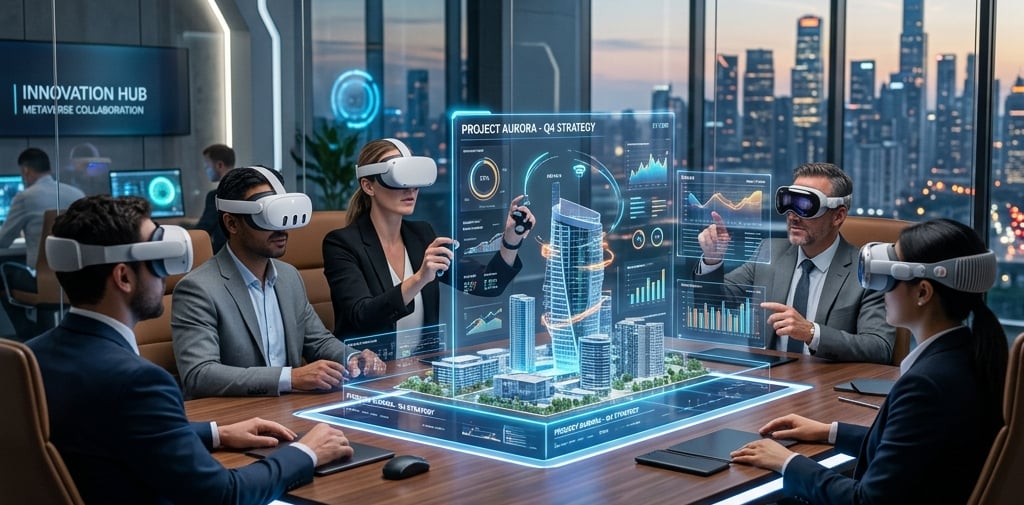
VR for Remote Collaboration and Meetings: The Future of Virtual Workspaces in
Blog Article
VR for Remote Collaboration and Meetings – The Future of Work Has Arrived
The workplace has evolved dramatically over the last few years. Traditional video calls and online meetings have helped teams stay connected, but they still lack one critical element — the feeling of real human presence. This is where Virtual Reality (VR) is redefining remote collaboration.
In 2026, businesses are no longer limited to flat video conferencing screens. Teams can now meet inside immersive virtual spaces, interact naturally through avatars, present 3D models, conduct training sessions, and even host global events — all from different parts of the world.
VR collaboration is transforming the way companies communicate, innovate, and work together.
What is VR Collaboration?
VR collaboration refers to the use of immersive virtual environments where employees, clients, and teams can interact in real-time using VR headsets and digital avatars.
Unlike traditional meetings, VR creates the sensation of physically being present in the same room. Participants can:
Walk around virtual meeting spaces
Interact with presentations and 3D objects
Brainstorm on virtual whiteboards
Attend training simulations
Conduct product demos
Host global virtual conferences
Popular platforms like Meta Horizon Workrooms and Microsoft Mesh are already shaping the future of immersive business communication.
Why Businesses Are Moving Towards VR Meetings
1. Real Human Presence
Video calls often feel disconnected and exhausting. VR meetings provide spatial interaction and realistic communication that makes conversations more engaging and natural.
Employees feel more connected, especially in remote work environments.
2. Better Team Collaboration
VR allows teams to collaborate in shared digital spaces. Designers, architects, engineers, and creative teams can interact with 3D models in real-time.
Imagine reviewing a building design, product prototype, or exhibition setup while standing inside it virtually.
This dramatically improves decision-making and reduces errors.
3. Cost Savings on Travel
Companies spend massive amounts on:
Business travel
Hotel stays
Exhibition logistics
Physical meeting spaces
VR collaboration eliminates many of these expenses by enabling immersive meetings from anywhere in the world.
4. Enhanced Training and Learning
VR-based training offers hands-on learning experiences without physical risk.
Industries using VR training include:
Healthcare
Manufacturing
Real estate
Education
Aviation
Industrial safety
Employees learn faster because immersive experiences improve retention and engagement.
5. Global Events Without Physical Limits
Businesses can now host:
Virtual expos
Product launches
Corporate meetings
Hybrid conferences
Metaverse events
Participants from different countries can join instantly, increasing reach and accessibility.
The Role of AI and Mixed Reality in VR Collaboration
The future is becoming even more powerful with AI integration.
Modern VR collaboration systems now include:
AI-generated avatars
Real-time language translation
Gesture recognition
Smart meeting summaries
Virtual assistants
Mixed Reality (MR) interaction
These technologies are making remote communication smarter and more realistic than ever before.
How 360 VR Photography Helps Businesses Enter the VR Era
At 360 VR Photography, we help businesses create immersive virtual experiences that go beyond traditional media.
Our services include:
Virtual Reality (VR) solutions
Augmented Reality (AR)
Mixed Reality (MR)
Extended Reality (XR)
360° Video Production
Metaverse Events
Virtual Product Launches
Live 360° Streaming
Interactive Virtual Tours
AI-generated immersive experiences
We help companies transform offices, exhibitions, educational spaces, factories, and events into engaging virtual environments that can be accessed globally.
Whether you want to create a VR collaboration space, a virtual corporate event, or a metaverse-based experience, our team can deliver end-to-end immersive solutions.
Industries Benefiting from VR Collaboration
Corporate Businesses
Virtual meetings and remote teamwork.
Real Estate
Virtual property walkthroughs and client presentations.
Education
Immersive classrooms and practical learning simulations.
Healthcare
Medical training and remote collaboration.
Manufacturing
Virtual factory planning and industrial training.
Event Management
Global virtual expos and hybrid conferences.
The Future of Remote Work is Immersive
As internet speeds improve and VR hardware becomes more affordable, immersive collaboration will become a standard business tool rather than a futuristic concept.
Companies adopting VR collaboration today are positioning themselves ahead of the competition by improving communication, reducing costs, and creating more engaging experiences for employees and customers alike.
The future office may not be a physical building — it may be a fully interactive virtual world.
Conclusion
VR collaboration is no longer science fiction. It is rapidly becoming one of the most powerful tools for communication, teamwork, and business innovation.
From immersive meetings to global virtual events, VR is helping organizations work smarter, connect deeper, and reach audiences worldwide.
Businesses that embrace immersive technology today will lead the digital transformation of tomorrow.

Experience
Engaging virtual tours for real estate and events.
Innovative
Immersive
info@360vrphotography.in
+91 9920322366