360° Photography for Education & Virtual Classrooms: How VR is Revolutionizing Learning
Explore how 360° photography and VR in education are transforming virtual classrooms, student engagement, and digital learning. Discover how 360 VR Photography creates immersive educational experiences.
VIRTUAL REALITY
🎓 360° Photography for Education & Virtual Classrooms: The Future of Learning with VR
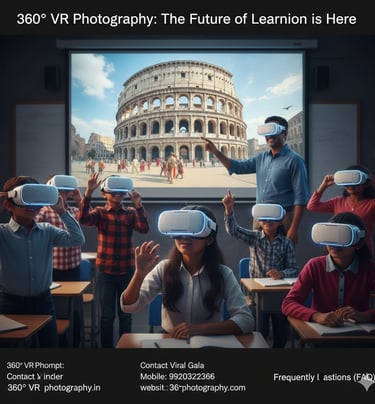
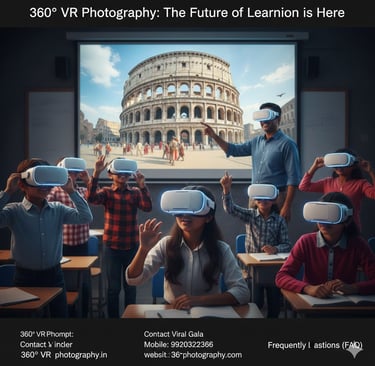
Remember when learning was just about books and lectures? Today, education is going through an incredible, hands-on revolution. Thanks to Virtual Reality (VR), students aren't just reading about history or science—they're stepping right into it. Imagine walking inside an ancient pyramid, exploring the complexity of the human heart, or attending a university lecture from a remote village. This isn't science fiction; it's the reality 360° photography is building right now.
At the core of this seismic shift is 360° Photography and immersive VR environments. They are turning passive learning into powerful, unforgettable experiences.
At 360 VR Photography, we're passionate about creating these next-generation educational VR solutions, helping schools, colleges, and training centers across India become truly future-ready.
📚 1. What Exactly is VR in Education?
Simply put, VR in education is all about learning by doing. Instead of just reading text, students engage with immersive digital environments where they can:
Learn by experiencing, not just memorizing.
Interact with complex 3D objects and models.
Enter virtual classrooms from any location.
Perform virtual experiments without the cost or risk of a physical lab.
Take field trips to places that were once geographically or financially impossible.
It’s about making learning more engaging, more memorable, and far more effective.
If you want a deeper dive into the technological background, check out the Wikipedia article on Virtual Reality in Primary Education.
🏫 2. Virtual Classrooms – The New Learning Environment
The traditional classroom model is breaking its physical boundaries. A virtual classroom is an environment where remote students don a headset (or even use a simple device) to:
Attend live classes remotely in a shared 3D space.
Interact with teachers using their own avatars.
Collaborate with classmates on projects in real time.
This technology is a game-changer for online schools, distance learning, and specialized skill training programs.
👉 Our Role: We don't just set up video calls; we create true 360° Virtual Classrooms, Live 360° YouTube Classes, and dynamic VR Training Spaces that make online education feel as real and personal as standing next to your professor.
A Human Perspective: While the technology is exciting, there's always a healthy debate about whether VR replaces human interaction. A popular discussion thread on Reddit about VR Classrooms highlights that the best use of this tech is to enhance and expand accessibility, not substitute the vital in-person connection teachers and students cherish. We couldn't agree more—it's a tool to amplify great teaching.
🧠 3. How 360° Photography Enhances Education
This is where the magic of 360° photography comes in. It takes the real world and makes it instantly accessible for immersive exploration. Instead of relying solely on imagination or static images, students get real-world immersion by being able to:
Explore professional science labs virtually.
Walk inside historical museums and monuments.
Visit live factories and industrial sites safely.
Tour school campuses remotely before enrolling.
👉 Our Role: We deliver high-quality Google Map Virtual Tours, detailed School Campus 360° Walkthroughs, Industrial Training VR Tours, and captivating Museum VR Experiences.
🏥 4. VR for Professional & Skill Training
The impact of VR stretches far beyond K-12 and university lectures; it's transforming professional training by offering safe, repeatable, and high-stakes simulations:
Medical Education:
Virtual surgery practice.
3D human anatomy dissection.
Emergency response simulations.
Engineering Education:
Machine operation training.
Factory safety drills.
Structural visualization.
Skill Development:
Electrical wiring practice.
Fire & disaster safety training.
Complex mechanical assembly.
👉 Our Role: We build targeted VR Training Modules, Industrial Simulation Tours, and skill-based VR learning content tailored for maximum retention and safety.
🧒 5. Why VR Works: Engagement & Results
The difference between passive listening and active experience is staggering. VR learning methods offer several powerful advantages over traditional, theory-based methods:
Active Experience: Replaces passive listening, turning observation into hands-on learning.
Full Immersion: Replaces limited imagination, allowing students to be fully present in the subject matter.
High Engagement: Replaces low attention spans, leading to better focus and interest.
Experience-Based: Replaces theory-based methods, allowing learning-by-doing.
Superior Retention: Studies consistently show that learners using VR can retain up to 4x more information than those using conventional methods. That’s the power of putting a student inside the lesson.
🌍 6. The Future of VR in Education
The journey is just beginning. Soon, we'll see:
AI-powered virtual teachers offering personalized tutoring.
Metaverse classrooms hosting real-time global collaboration.
Fully interactive, adaptive textbooks that respond to student progress.
The entire educational paradigm is shifting from: “Read & Remember” → “Experience & Learn”
💡 Frequently Asked Questions (FAQ)
Q: Is VR technology affordable for schools? A: Absolutely. While high-end VR is available, accessible solutions like Google Cardboard and mobile VR (using a standard smartphone) make 360° content affordable for any educational institution looking to pilot the technology. The cost savings on physical field trips and lab materials often offset the initial investment quickly.
Q: Does VR replace the physical teacher? A: No. VR is a tool that empowers the teacher. It helps them convey complex information more effectively and manage virtual resources, but the human element of guidance, mentorship, and critical thinking remains crucial.
Q: What kind of content can 360° photography provide that video can't? A: 360° photography provides a static, high-resolution, explorable environment, perfect for virtual campus tours, detailed lab inspections, or historical site visits where the user needs time to look around and focus on details at their own pace. 360° video is better for sequential experiences like a live surgery or a complex machine demonstration.
Q: How do we get started? A: Start small! We recommend launching a Google Map Virtual Tour of your campus or creating one skill-based VR training module to show the immediate impact on engagement and learning outcomes.
🎥 Recommended Video for Further Learning
To see exactly how a university can leverage 360° media, we recommend this insightful video:
Title: CPD Webinar: Using 360° images and videos to create VR spaces for Education Source: YouTube Link Summary: This webinar breaks down the process, equipment, and challenges of building a library of virtual spaces for students, covering everything from high-end headsets to simple web browser viewing. It's a great starting point for understanding the production side.
🤝 Let’s Build the Future of Education Together
360° Photography and VR are more than just fancy tech; they are essential tools for attracting the next generation of students, improving learning quality, and helping institutions stand out digitally.
Ready to bring your school or training center into the future?
Contact Viral Gala
Company: 360 VR Photography
Phone/WhatsApp: +91 9920322366
Websites: 360vrphotography.com and 360vrphotography.in
Location: Serving schools, colleges, and institutes across India.

Experience
Engaging virtual tours for real estate and events.
Innovative
Immersive
info@360vrphotography.in
+91 9920322366